
Free download
Harvest log template
Print it, or open it in a spreadsheet. One page of ruled rows for the kitchen counter or the shed door, and the same columns as a CSV for Excel, Numbers or Google Sheets. Free, with no email needed.
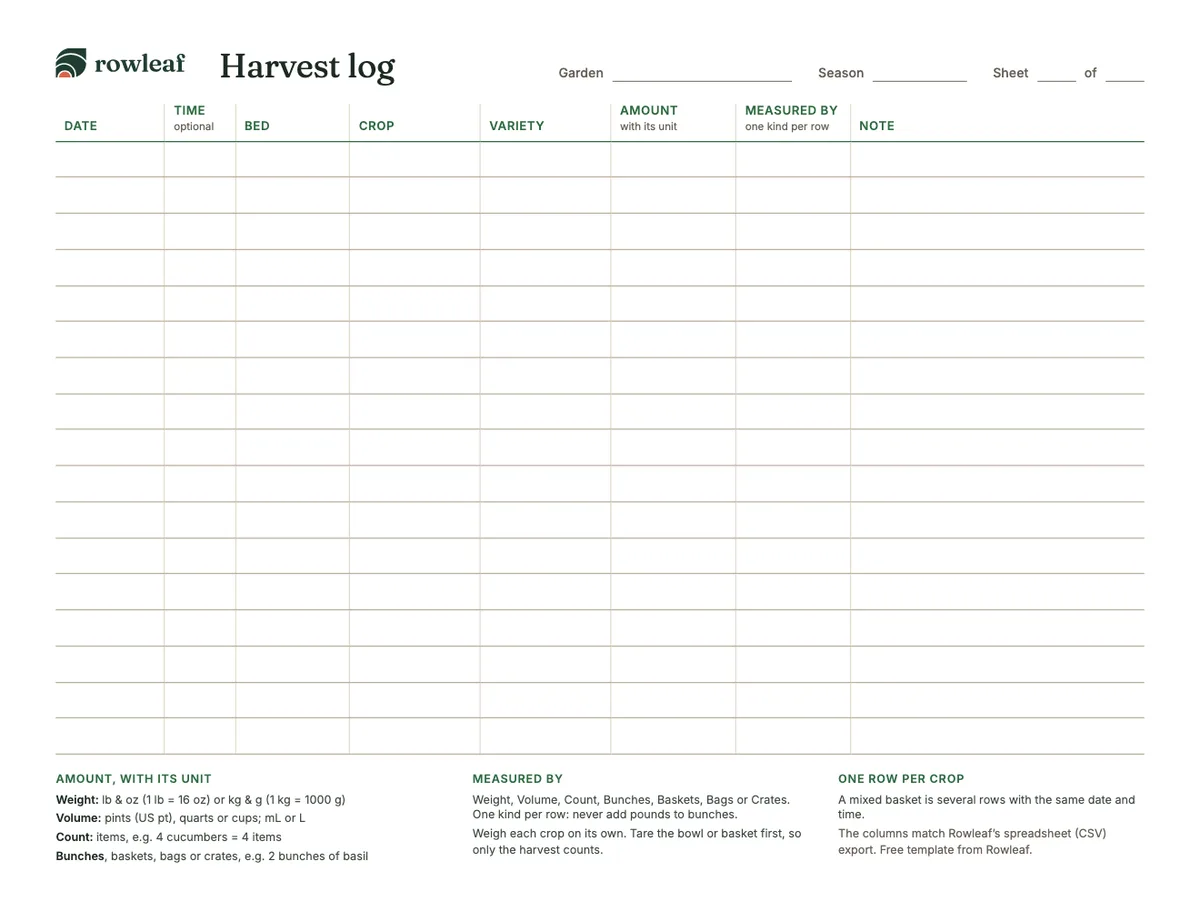
Printable sheet
One landscape page that prints at actual size on US Letter or A4.
Download the PDFSpreadsheet
Twelve columns and six filled-in rows to copy over or clear.
Download the CSVHow to use it
- Print a few sheets and keep them where the harvest lands: on a clipboard by the door, with the scale and a pencil.
- Write one row per crop, each time you pick. A mixed basket is several rows with the same date.
- Write the amount with its unit, and say how you measured it. Weigh what you’d weigh, count what comes one by one, and bunch herbs and greens.
- At the end of the month or the season, add up each crop, one kind at a time: pounds with pounds, bunches with bunches.
New to keeping a log? How to keep a garden harvest log covers what to record and how to read a season back. For the scale, see How to weigh and record your harvest.
What goes in each column
- Date
- The day you picked. The CSV writes it as 2026-07-02, like the export does.
- Time
- Optional. Handy when you pick morning and evening. 24-hour in the CSV (18:30).
- Garden
- Which plot, if you have more than one. On the printed sheet it goes once, at the top.
- Season
- Usually the year. Also once at the top of the printed sheet.
- Bed
- The bed, row, pot or patch it came from. Leave it blank if you don’t track beds.
- Crop
- One crop per row, written the same way every time, so “Tomato” and “tomatoes” don’t add up as two crops.
- Variety
- Optional, but worth it when you grow two kinds of the same crop.
- Amount
- The number with its unit, as you’d say it: 1 lb 6 oz, 4 items, 2 bunches, 2 US pt.
- Measured by
- Weight, Volume, Count, Bunches, Baskets, Bags or Crates. It keeps the kinds apart when you add up.
- Standard amount and unit
- CSV only, and optional: the same amount in grams, milliliters or items, so a spreadsheet can total “1 lb 6 oz” and “12 oz”.
- Note
- Anything you’ll want next year: first ripe ones, split after rain, too many to count.
Units, briefly
- Weight: pounds and ounces (16 oz to the pound) or kilograms and grams. 1 lb 6 oz is 1.375 lb, not 1.6 lb, so write it the way the scale shows it.
- Count: items, for cucumbers, peppers, heads, squash and corn.
- Volume: pints for berries and cherry tomatoes, or quarts and cups.
- Bunches, baskets, bags or crates for herbs, greens and radishes.
In the spreadsheet, one pound is 453.59237 g, one ounce 28.349523125 g and one US pint 473.176473 mL, if you want to fill in the standard amounts and total a crop across units.
If you move to an app later
We make Rowleaf, a harvest journal for iPhone and Android, and its free spreadsheet export (Garden → Backup & export) uses these column names in this order. The export adds a few columns the app fills in for you: time zone, prices and value, photo, when each entry was added and edited, and IDs. Rowleaf doesn’t import spreadsheets, so a paper season stays on paper, but when you compare seasons in one spreadsheet the columns match.